Monday, December 4, 2017

Human Rights Awards Reception - Spotlight! on Nancy Rivard

By Christina M. Hansen, UNA-NCA VP of Programs and Human Rights Committee member
UNA-NCA will be holding their Annual Human Rights Awards Reception this year on Thursday, December 7th and is pleased to present this year’s Perdita Huston Award to Nancy Rivard, the founder and President of Airline Ambassadors International. We are pleased to shine a light on Ms. Rivard’s amazing work in support of human rights.
UNA-NCA: Can you tell us a little about yourself and what motivated you to create Airline Ambassadors International?


NR: When my dad died suddenly at age 54, it was a wakeup call for me. I was a supervisor of flight attendants at American Airlines and climbing the corporate ladder. It prompted me to take a step backwards professionally to take a step towards my soul.
I returned to a flight attendant position to embark on a deep and profound search for meaning that lasted 7 years and took me all over the world. I had the idea that flight attendants could bring love into action by directly helping vulnerable children, inspiring the traveling public to do the same.
I could only get two flight attendants to join me on our first mission to Bosnia... The next month I escorted a child back to Cali, Colombia who had received donated surgery in the U.S. Flight attendants began to ask me to put them on my "list," and by 1995 we had 500 names on the "list" and started a nonprofit corporation in the office of the late Congressman Tom Lantos.
UNA-NCA: UNA-NCA supporters are avid travelers; what are some things we should be aware of when we travel, and what should we do if we think we see an individual who may be at-risk of being trafficked?


NR: All of us who travel frequently should be aware that human trafficking is the fastest growing critical industry and that according to the 2017 report from the ILO and Walk Free Foundation, there are estimated to be over 40M trafficking victims. Traffickers move their victims frequently and often use the speed and convenience of commercial air travel. Travelers can pay attention to children and notice who they are traveling with. Does the young person seem frightened, ashamed, or nervous? Are they under the control of a traveling companion? Are they unsure of their destination? Do they have wounds or bruises? If something doesn’t seem right, it is the traveler's duty to report it to law enforcement. They may be wrong, but this action can save a life.


UNA-NCA: What should we know about human trafficking survivors?


NR: We work with survivors for all our trainings, which makes the issue come alive, and helps trainees understand that this can happen to anyone, young, old, male, female, etc. They are lured in by promises of romance, a better life, or through threats (force, fraud, or coercion) by someone willing to exploit them for profit. Many times trafficking victims do not realize they are a victim, and will not or can't self-identify. Some say the lifespan of a person that enters into this "life" averages about 7 years; but even if a person is rescued, the psychological scars can remain a lifetime. This is why we need to "see" them and be willing to recognize and report potential trafficking situations as soon as possible.


UNA-NCA: Your organization does so much to help vulnerable people, especially children. Can you tell us more about your humanitarian and medical programs?


NR: Every month our teams volunteer their time to escort children to the U.S. for donated medical care. We have been able to provide 3000 of these life changing journeys so far. We also hand deliver food, clothing, school supplies, hygiene items and more to children in children's homes or orphanages worldwide every month and have helped 500,000 children in 62 countries. We make a long-term commitment to children at our projects and have been successful in getting all 75 children at our Philippines project sponsored and are working on this for kids in Haiti as well. AAI also aids disaster relief. We have moved 47 entire airplanes of aid and hand delivered $60 million worth of humanitarian assistance directly to children and families.


UNA-NCA: How has your partnership with the United Nations affected your work?


NR: The United Nations conference series such as the Earth Summit, Social Summit, Human Rights, Women's Summit, and Habitat 11 helped to shape my understanding that global solutions were needed for the problems we face as humanity. AAI is honored to be affiliated with the United Nations Department of Information and also the Economic and Social Council. We maintain UN Representatives in New York and participate at meetings and conferences there. As an ECOSOC NGO, we were able to call a Side Event at the recent Commission on Crime Prevention Global Meeting of UNODC, drawing global attention to our work in the prevention of human trafficking resulting in an MOU with UNODC. We also measure our effectiveness each year based on the Sustainable Development Goals of the United Nations.
UNA-NCA: Which of the new Global Goals, as they relate to Human Rights, is most important to you personally and why?


NR: In the past few years Airline Ambassadors work has expanded with the prevention of human trafficking, the most important human rights issue of our time. SDG's, 8.7, 5.2 and 16.2 relate to this specifically,
AAI supports all of these goals as human rights is the basis of all our efforts.


UNA-NCA: You are being honored with the Perdita Huston Award, named after a woman who dedicated her life to supporting the rights of women and girls around the world. How has your work helped promote gender equality?


NR: The empowerment of girls has been pivotal to our work and still is as we strive to bring human rights, education, job training, and support for women and girls to each of the projects we support. Gender equality is a core principle of what our work is about.  


UNA-NCA: Eleanor Roosevelt once said that unless human rights have meaning locally, they have little meaning anywhere, and that "without concerted citizen action to uphold them close to home, we shall look in vain for progress in the larger world." What are your reflections on that, and on what that means for action and prioritizing action?


NR: I think Eleanor Roosevelt was a brilliant and inspired visionary and agree with her entirely that we have to "walk our talk"- have the courage to speak out for injustices we see in our own neighborhood, or, as a flight attendant, to report a potential trafficking case on an airplane. Many individuals, governments and companies think it is easier to close our eyes, and not get involved, not make waves, but in the long run that does not serve us, or our world. As the late Tom Lantos said "The veneer of civilization is paper thin, we are its guardians, and we can never rest."
UNA-NCA: In your opinion, what has been your greatest impact on trafficking and humanitarian issues and human rights?


NR: No doubt our selfless humanitarian flying angels have made a difference in the lives of countless children through our medical escort and humanitarian programs. AAI gives ordinary people a chance to match their unique skills and interests to world. We have the children's pictures in our wallet, we communicate with them, and love them. It meets a need for them by helping to provide the physical things they need, but they meet a need in us too, giving us a chance to express our fundamental kindness, compassion, and generosity.

Recently our work advocating for human trafficking awareness is more about educating airport/airline personnel. We saw an opportunity to make a difference that would impact thousands of victims and we knew we had to take a stand. I do believe our efforts helped in the passage of the FAA Reauthorization Act of 2016, requiring that flight attendants be trained on human trafficking. It was an important victory.

Human Rights Awards Reception - Spotlight! on Ambassador Keith Harper

By Tselmegtsetseg Tsetsendelger, UNA-NCA Human Rights Committee member

UNA-NCA will be holding their Annual Human Rights Awards Reception this year on Thursday, December 7th and is pleased to present this year’s F. Allen "Tex" Harris Diplomacy Human Rights Award to Ambassador (ret.) Keith Harper, the former United States Ambassador and Permanent Representative to the United Nations Human Rights Council.

Ambassador Harper is a citizen of the Cherokee Nation of Oklahoma and has focused his practice on Native American affairs as well as international clients as a current partner at Kilpatrick, Townsend & Stockton, LLP. UNA-NCA is recognizing the invaluable undertakings Ambassador Harper took relating to human rights domestically and internationally. Here are some insights he shared with us concerning his Ambassadorship, the UN Human Rights Council, and more.

UNA-NCA: How does your experience as a diplomat shape your understanding of human rights?

K.H: I have long believed that the advancement of human rights is not only the right thing to do but also the smart thing to do. It is self-evident that treating individuals fairly and honoring the dignity of each person is morally right. We often overlook though, that greater respect for human rights is also key, along with promoting rule of law, to set the foundation and sustaining greater stability, security and prosperity.

As a diplomat representing the United States promoting human rights, I better appreciated how our collective diplomatic work remains essential to establishing a world more observant of human rights norms. And it also became increasingly clear to me the essential necessity of American leadership. To be sure, the United States relies on our partners, but it is equally clear that we play a critical role as a leader of the free world. If the promotion of human rights is to be successful, America has to continue to do its part. 

“I have long believed that the advancement of human rights is not only the right thing to do but also the smart thing to do.  It is self-evident that treating individuals fairly and honoring the dignity of each person is morally right.”

UNA-NCA:  Can you share a key personal takeaway from your time as an ambassador to the Human rights Council (HRC)?

K.H: The Human Rights Council is an imperfect institution but nevertheless plays an exceptionally critical role in promoting the protection of human rights. Often, we focus on that which the HRC has failed to do – it cannot stop the conflict in Syria nor prevent the humanitarian disaster in Yemen – nor frankly is it equipped to do so. What the Council can do is focus the world’s attention and document human rights violations and abuses.

In some instances, these actions can bring about changes on the ground as it did in Sri Lanka. In other instances, the HRC’s initiatives can lead to a fundamental shift in the international dialogue as occurred after publication of the Kirby Commission of Inquiry report on human rights situation in North Korea. The effectiveness of the Council is not preordained. So among the key takeaways for me is that our collective engagement matters but we also have to constantly ask the question in a world of limited resources – Will this action lead to some measurable change? 

UNA-NCA: Your work before becoming ambassador focused more nationally than internationally. How has your experience at the HRC impacted your perspective of both international and domestic human rights efforts, and what do you see at the intersection of that?

K.H: Certainly, there are important distinctions between work to secure legal rights of individuals or communities in domestic settings as contrasted to the international sphere. For one thing, domestically, there is usually more effective enforcement of rights through judicial proceedings. As a litigator representing Indian Tribes, my experience domestically was to advocate—principally in the federal courts—for enforcement of rights on behalf of tribal communities. Domestically, you can bring a court action, make your case and be granted relief. But the courts are also equipped to enforce their rulings with orders and coercive powers including contempt where necessary. This stands in stark contradistinction with enforcing international human rights norms internationally.  As with most international norms, the enforcement through political tools. This is the importance of treaty bodies and the High Commissioner and his office as well as bodies such as the Human Rights Council. Promotion of human rights takes concerted attention and effort from nations and nongovernmental entities. It requires the exercise of political coercion—shaming and documentation of abuses—and in rare cases economic coercive measures utilized against states transgressing settled norms.

UNA-NCA: You had quite a transition this year. What are you doing now and what are your plans for the future?

K.H: I have returned to practicing law as a Partner at Kilpatrick, Townsend & Stockton, LLP, the firm I was at prior to my ambassadorial tenure. I am also a Non-Resident Senior Fellow for National Security Policy at George Washington University Elliott School of International Affairs. I am doing a mixture of representation of tribal nations in litigation and development projects as well as advising clients on navigating multilateral institutions and guiding various projects internationally. 

UNA-NCA:  Eleanor Roosevelt once said that unless human rights have a meaning close to home/locally, they have little meaning anywhere, and that "without concerted citizen action to uphold them close to home, we shall look in vain for progress in the larger world." What are your reflections on that, and on what it means for action and prioritizing action?

K.H: Eleanor Roosevelt’s words resonate today because they capture a timeless truth. Human rights must be real on the ground and close to home. If freedom of the press or freedoms of speech, assembly, and association are under threat “close to home,” it makes it far more challenging—perhaps impossible—to effectively promote these and other rights globally. One of the things that should hearten us over the last year is the engagement of Americans in all levels whenever there has been a threat to our shared values or the undermining of our national norms. This is precisely the reaction we should have.     

“One of the things that should hearten us over the last year, is the engagement of Americans in all levels whenever there has been a threat to our shared values or the undermining of our national norms.  This is precisely the reaction we should have.”     

UNA-NCA:   In a similar vein, the US is still involved in the HRC as of now and we hope it will continue to be part of it. What are things we, in the States, and in the Nation's Capital particularly that can be doing to strengthen our involvement and to foster positive and accurate understanding of the UN, the HRC, and the importance of US involvement?

K.H: We have to do two things in my estimation. First, we have to be honest about the HRC’s flaws. It is inarguable, for example, that the Council has a hyper-focus on one country – the State of Israel. It is true that we have chipped away at this bias through active US engagement. But there is far more to do and we have to be steadfast in addressing this and other flaws that undermine the HRC’s credibility. Second, we have to be far better in discussing the many effective initiatives at the Council—many of which have had real world impact. To appreciate an institution, the world needs to know what its usefulness is. It can be uncomfortable to talk about success—but in this case it is vital to aiding the public to understand why it is critical to continue to engage at the HRC. 

UNA-NCA: Which of the new Sustainable Development Goals (SDGs) as they relate to Human Rights is most important to you and why?

K.H: This is a very difficult choice. My heart is attracted to Goal 1, ending poverty, and my mind to Goal 13, recognizing the criticality of collective climate action and Goal 16, which understands the need for peace and strong institutions as foundation for successful development. But if I had to choose one it would be Goal 5 – Gender Equality.


Policies, especially on something so essential as development, should be data driven.  And what the data reveals is that countries who address rights of women and girls effectively—the full panoply of rights, including equal access to education, access to capital, addressing violence against women, elimination of nationality law discrimination, etc.—set themselves up for effective and sustainable development.  And countries who fail to effectively promote rights of women and girls completely retard their economic development. Donor countries should be clear that they will support development strategies when they include gender equality and empowerment of women and girls—because that is an essential component of what will work.

Wednesday, November 29, 2017

Human Rights Awards Reception - Spotlight on George A. Jones

by Lanice Williams, UNANCA Human Rights Committee Member
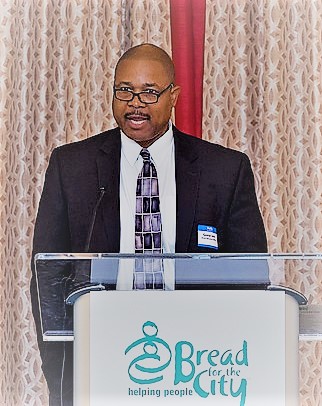
The United Nations Association of the National Capital Area Human Rights Awards Reception will take place on Thursday, December 7, and amongst our distinguished list of awardees, we are pleased to highlight one of our award recipients;  Mr. George A. Jones.
Currently, Mr. Jones serves as the Chief Executive Office for Bread for the City and will receive our Distinguished Community Human Rights Award on behalf of Bread for the City. His human rights works have focused a great deal on social justice, homelessness, and poverty alleviation sector and we also had a great conversation about his work, life, and pursuit of human rights.  
If you have ever wondered what connection exists between poverty, nutrition, and health and what Bread for the City is doing to combat these issues in the nation’s capital,  you should definitely take the time to hear what he has to say.


UNA-NCA - You have been with Bread for the City since 1996. What was it that brought you to the organization, and what has kept you there for so long since?
G.J. - I came to the organization from Los Angeles, California. It’s important to know that before Bread, I had already been in the social justice space for around 14 years. I had always tried to find how to help people struggling with low income, homelessness, chronic unemployment, and those types of challenges. So when the opportunity to join Bread for the City came along, I had done a whole range of things that in some way qualified me to lead this work. So I feel this was a calling, and honestly, this does not feel like work to me, because I have always stayed on fire trying to help improve the conditions of the people that turn to Bread for the City, so it feels natural to me doing this type of work.
UNA-NCA - Bread for the City offers a wide array of very specific services to clients. Why these particular services and service areas? How did they come to be selected, are others ever considered, and do any of them ever get "retired?"
G.J. - We provide various programs, including Food, Clothing, Medical, Legal, Social Services, and we support community members in advocacy spaces. Those programs came together in an organic way, initially by the merging of our two original organizations. Zacchaeus Free Clinic began in 1974 as a volunteer-run free medical clinic, and Bread for the City was created in 1976 by a coalition of downtown churches to feed and clothe the poor. The two entities decided to merge their efforts in 1995. Both organizations decided to co-found our Social Services Program, so actually, the current programs evolved partly because of the conjunction that happened, and also because these type of issues were fundamental challenges for our clients.
Do we ever retire these programs? Well, our core programs have remained intact since their beginning, but we do have some initiatives that sometimes we step away from, and decide that they are no longer relevant to the community, and therefore to us.
UNA-NCA - Your mission statement notes that you work to help "DC residents living with low income to develop the power to determine the future of their own communities" and "seek justice through community organizing and public advocacy [and] work to uproot racism, a major cause of poverty." Can you talk to us about this mission? It seems like a large challenge to take on for many reasons, not least of them the current conversations around racism in the country today.
G.J. - Bread for the City’s mission has recently been renewed; it has moved from simply talking about how we help people to really emphasizing the way we work with the community, in order for them to use their own power to support themselves. We talk about assisting community organizers so they can seek social justice based on their own needs instead of us, Bread for the City’s staff, being their spokespersons. We talk about public advocacy as being a really important piece of reforming the systems that we know perpetuates poverty. We remain committed to providing direct services that serve as a safety net for our community members, but now we believe we have to also stress the need for public policies reform that can help to make our direct services less and less relevant.
Addressing the disparities that exist in housing, income, employment, the criminal justice system even, is going to be key if we want to create an equal community. I also think our mission has lifted up the notion that we want to take on racism as a direct cause of the social economic disparities that affect people of color almost exclusively. Whether you’re talking about housing, income, or even arrest, these challenges too often affect people of color, so we understand it’s important to name that. Only when you name it can you deal with it directly, and only then you are able to figure out how to reverse the patterns that have played themselves out in these ways.
UNA-NCA - In a related question, since part of what you work on is community organizing and public advocacy, what does that look like in your work? What are your thoughts about the power of having a voice and how we shape and use that?
G.J. - As I mentioned before, when it comes to our community organizing and public advocacy work, it’s a transition that is taking place where the voices that are being listened to and that we are amplifying in public discourse are less and less the voices of Bread for the City’s staff and now, it’s our community members’ voices. We created the Terrance Moore Organizing Institute, named after one of our former clients that passed away years ago. This institute has created space for community members to get training on the fundamentals of advocacy work; we are teaching them how to tell stories, understand public policy, organize their neighbors and perform outreach to community members, and those kinds of things that are fundamental for social mobilization. We teach them how those pieces work together so they understand the mechanics of advocacy. We are trying to be supportive in terms of making it realistic for them to go out and advocate, so there’s not only the learning part, but also the action part: we want them to be involved and want them to be engaged in addressing these challenges to advocacy, like child care or transportation. This is important because sometimes people forget that they can show up to places and be powerful, and actually achieve things.
UNA-NCA - Bread for the City is not just a local organization; you're an organization that is addressing issues at the core of the nation’s capitol. How do you see the importance of this community and the work you do on the national level - and on the international level?
G.J. - This is very simple: it’s at home where the example needs to be set. So, if we are going to address the values of human rights and social justice and be a leader here in DC, and if the District Government is going to see itself somehow as a leader nationally in terms of justice, and if this country is going to perceive itself in being a world-leading nation, we have to lead by example.
That’s the main reason why Bread for the City is focusing on being an anti-racism and social justice institution in every single way. Our politics, our practices, our staff, everything surrounding our work needs to demonstrate these values, and so does the DC Government, and so does the national government, because if we want to be a leader in the city, and the city in this nation, and this nation in the world, as I think all of us do, that leadership requires us first and foremost, to act in ways where we can become that more perfect union.
What I love about Bread is that we get what this means: we are always seeking ways to become better than we were yesterday, not only at a local level but also in a national level. A great example of this is that we sued the federal government to compel the U.S. Department of Agriculture, its Secretary, and its Food and Nutrition Service to comply with Congress’s unambiguous mandate to provide billions of dollars of food to emergency organizations who feed the needy and homeless. This was a civil action suit where we acted on behalf of the entire country and hoped that the court would agree that the founding law was being improperly interpreted. Unfortunately, we lost that lawsuit on appeal, but it served as a great example of how even just one organization can try to take on a system as large as the United States Department of Agriculture. While the outcome wasn’t what we hoped for, we stood proud knowing that we used our voice to spread the message about food and racial justice in the states.
UNA-NCA - Eleanor Roosevelt once said that unless human rights have the meaning close to home/locally, they have little meaning anywhere, and that "without concerted citizen action to uphold them close to home, we shall look in vain for progress in the larger world." What are your reflections on that, and on what that means for action and prioritizing action?
G.J. - Justice starts at home. When you are talking about Bread for the City and our own policies and services, it all comes down to having a real meaning and authenticity around justice and equity.  If we don’t have that, we don’t have the right to go to DC City Council and speak to them about justice and equity, and the same happens nationally with the federal government. Justice has to be prioritized at home, if you are going to talk to the city and the rest of the world about how values of justice and human rights should lead modern societies, if we want to be seen as the beacon of change, we have to walk the walk and not just talk the talk.
UNA-NCA - Which of the new SDGs as they relate to Human Rights is most important to you personally and, that you would say, to Bread for the City, and why?
G.J. - The obvious answer for an organization like Bread for the City, where we talk about poverty hunger and health on a daily basis, is that the goals of No Poverty, Zero Hunger, and Good Health and Well-Being are the central goals for us. But to be honest with you, all of these goals are built upon each other and in some ways they hold each other together. If you think about it, these goals together will create a world with the purest level of justice you can find. It will take a lot of creativity to accomplish this, and all the talents we have in the world, and all of the people who are in these spaces linking efforts to make change more effective than we have ever had before. I would like to add, though, that the notion of racial equality is kind of missing in these 17 goals. I suppose it’s implied in Reducing Inequalities, and in Peace and Justice even, but it might be worth considering whether to talk about ending racial disparities in an explicit way, because this isn’t just a problem in the U.S., it’s a worldwide problem. The color line still decides too often who has or who does not have; it might be the right time to stress it as one of the SDGs.

Friday, October 6, 2017

A Conversation with UN High Commissioner for Human Rights: Zeid Ra’ad Al Hussein

By Esther Jung, Global Classrooms DC Program Assistant

On September 18, the Carnegie Endowment for International Peace hosted a lecture with Carnegie President William J. Burns and UN High Commissioner for Human Rights Zeid Ra’ad Al Hussein. The discussion focused on the role of national and international leaders promoting humanitarian efforts and human rights and how they can take action in this changing global landscape. High Commissioner Al Hussein addressed a variety of current international issues, and highlighted the significance of humanitarian and human rights activism, especially in the changing political climate in the US.


High Commissioner Al Hussein raised an interesting point by referring to the entire international system as a ‘fading memory.’ While discussing the personal role of the UN High Commissioner and the role of the UN Human Rights Council, High Commissioner emphasized the increasing threats against the international system, whether it would be the security system, the financial system, or the rights-based system. With that being said, many people have addressed the problematic issue of seating documented violators of human rights as members of the Human Rights Council, such as Saudi Arabia (fact check?). 

In response, the UN High Commissioner stressed the importance of bridging a country’s internal beliefs and its external preaching. As we recall the ‘memory’ or antecedents of the system itself, it is important for the international system to continuously use the agency of shame to put pressure on these countries so that they confront these internal and external inconsistencies. 


In one instance, the High Commissioner expressed deep concerns about the changing role of United States in its commitment to the fundamental beliefs of the international system. He referred to US President Donald J. Trump’s criticism against singling out the media and the free press in Arizona shortly after Charlottesville. He warned against singling out the media and individual journalists because it creates a ‘climate of intimidation’ within the country but it also has a precedence for other countries like Cambodia who cited Trump’s comments, following a restriction on their public radio.  

The discussion was followed up with a series of hard-hitting questions about severe human rights violations across the world. During this time, many local news outlets asked questions about Iran, Turkey, Uzbekistan, Burma and Ethiopia. 

As the High Commissioner addressed each question, he continued to refer to the fragility of this world. “As humanity, we have broken the world twice, we can break it again,” he said. As such, the High Commissioner pressed the importance of the UN institution, but also recognized all defenders of human rights across the world who risk everything and symbolize this hope for mankind. 


It was quite an honor and pleasure to have had the opportunity to listen to the UN High Commissioner of Human Rights who spoke with great charisma, honesty and hopefulness for the future. As a student, it inspires me to work harder in hopes to be one of the many defenders of human rights in the future. 


Thursday, September 21, 2017

Why Model U.N. Matters: Thinking Outside the Box


by Taylor Dumaine 

Taylor Dumaine served as a Global Classrooms DC Program Assistant during the summer of 2017. She currently attends the George Washington University, and is entering her junior year in the Elliott School of International Affairs. She's majoring in International Affairs with concentrations in development and Asia.

My high school experience can be summed up pretty well by the fact that I was voted “Most Opinionated” by my peers. While winners of this superlative in years past saw this as a bad thing, and others thought it was a mean superlative, I was in my element.

I was proud of my ability to think for myself, research issues, and come to an informed consensus about those issues. A lot of this is thanks to Model UN, and especially my coach and teacher Mr. DiNardo. 

Entering high school, I already knew that I loved international affairs and that I wanted to be a part of the team, although I did not join until my sophomore year. Going into it, I wasn’t a soft quiet kid – in fact, I was already pretty well-known for speaking my mind. 

Model UN and Mr. DiNardo taught me to put a little more thought into my opinions before opening my mouth so that I could be more persuasive and engage in a better dialogue on issues. I was consistently challenged to represent positions I didn’t agree with, and represent countries that had opposing positions on nearly every issue I cared about. But those challenges expanded my knowledge and understanding on those topics and about international affairs in general. 

Mr. DiNardo was also my AP US History and AP Government teacher for my last two years of high school. Having a role model and mentor who treated me and my passion seriously, while also helping me to grow as a thinker, a student, and a person, was an invaluable experience that has had a profound impact on my life. 

Model UN encouraged me to think outside the box and speak up, but not before I carefully thought through the reality of certain topics and situations. It teaches kids to think critically not just about international issues, but also solutions and how various organizations and stakeholders are working on the solutions. 

While I was a crisis delegate for most of my Model UN career, I was able to tackle current international issues in historical and fictional contexts, challenging me to think as creatively as possible. Working in the ad hoc UN Security Council committee kickstarted my engagement with current events and the role of the international community in those events. 

I believe Model UN is one of the best things for young people to get involved in to grow into a better researcher, debater, and thinker. 

___________________________ 

This is part of a series by Global Classrooms DC, an education program under the United Nations Association of the National Capital Area that uses Model United Nations as an activity and tool to teach international issues and geopolitics to students grades 5 – 12. Many of the current and former interns and staff have participated in Model UN, and for many it has been a reason for the field we study and ultimately has a soft place in our hearts. This series was sparked by the recent publication of “What Model U.N. Is, and Why It Matters,” by Spencer Mariotti in The Huffington Post – Teen Edition 

Monday, June 26, 2017

U.S. Senator Bernie Sanders on Threats to Democracy

By: Tiffany Monroy
Program Assistant, UNA-NCA

On June 22nd, the Carnegie Endowment for International Peace hosted a conversation with U.S. Senator and former Presidential candidate, Bernie Sanders. Sarah Chayes, a Senior Fellow in Carnegie’s Democracy and Rule of Law program, facilitated the discussion on threats to democracy.

Senator Sanders, having recently returned from a European tour, reflected on his experience abroad, discussing looming threats to democracy and the resulting implications of those threats. Authoritarianism emerged as the most central of these threats. He highlighted the troubling universal shift in an authoritarian direction, not just in the United States, but also abroad. He described a resurgence of a politics of bigotry and resentment, led by leaders who only serve to further the growing divide between people.

The distinction between partisanship and the threat of authoritarianism to our democracy is critical, the Senator from Vermont expressed. Disagreement is not of surprise to anyone. In fact, it is a fundamental and important aspect of democracy. Still, he argued, we should be prepared to listen and engage with disagreement. No matter our perspective, we must do everything in our power to promote the system that allows us the ability to hold opposing views. The President’s recent budget proposal serves as a perfect example. Debate over the proposal can and will be had, but it is in the ability to debate in the first place that the beauty of our system lies.


Authoritarianism poses a threat to the system we cherish. Our democracy faces the threat of a system in which opposing views are not only discouraged, but eliminated. The threats to our democracy are tangible. Blatant disregards towards the sanctity of the Judicial branch and a shift in affection towards once-scorned authoritarian leaders are merely latest examples. The threats are not solely domestic, though. Authoritarianism implies a disengagement with the international community. U.S. disengagement from issues abroad would create a vacuum, Senator Sanders explained, that would allow for a climate of terror to prevail. What are we saying to those abroad who fight each day to establish and preserve democracies, if the United States, the model of democracy, does not fight to preserve our own? We must oppose these threats. We must preserve our system and reject this shift towards intolerance and injustice. Simply put, we must oppose authoritarianism, not only for the sake of our democracy, but also for the sake of the democracies of our neighbors.

So, what is the way forward? Coming together. Senator Sanders called for each of us to come together, no matter our views, to raise the issue and talk about moving forward. “Our duty is to respect our constitution and democracy, we must come together to protect the country we love, improve democracy, and stand up against those who want to move us towards authoritarianism,” he explained.

Acknowledging our differences is merely the first step towards eliminating authoritarianism from our system. The world in which we live faces problems, and it is our job to come together, not as Democrats or Republicans, liberals or conservatives, left or right, but as Americans. We must recognize our disagreements, put them aside, and remind ourselves that democracy is the common denominator.

Monday, June 19, 2017

2017 Nature Summit: Celebrating World Environment Day at the Embassy of Canada

By Alexandra S. Gross
Program Assistant, UNA-NCA

On June 5, 2017, UN Environment’s North America Office brought together an enthusiastic, multi-talented set of panelists who convened to share their individual ideas and experiences in regards to environmental advocacy. The Nature Summit was hosted by the Embassy of Canada in Washington, DC to celebrate this year’s World Environment Day. The theme, “connecting people to nature,” ignited in-depth discussion among speakers and guests pertaining to the development of effective, innovative strategies for promoting environmental awareness. Given the abundance of conflicting voices in the current public sphere surrounding issues of climate change and sustainable action, it is critical now more than ever before to strengthen the the global community’s engagement to protecting the planet.

The day’s program was moderated by David de Rothschild - British adventurer, ecologist, environmentalist, storyteller, and head of the Sculpt the Future Foundation. De Rothschild emphasized that all members of society, especially its leaders, must strive to fully embrace the intersection of communication, technology, science, and psychology when forming solutions to international problems. Such partnerships can be enormously valuable when it comes to the specific challenges of protecting endangered species, preserving healthy ecosystems, and reducing mankind’s carbon footprint and its harmful behaviors.

WED.jpg
Élisabeth Lacoursière, Director of Outreach and Marketing for Parks Canada, was one of the first panelists to speak and shared her firm belief that the more exposure people gain to experiences in nature during their early lives, the more likely they will be to protect and care for it throughout their lifetimes. Sean Southey, CEO of PCI Media Impact and Chair of IUCN Commission on Education and Communication, built on her idea and challenged the audience with the thought-provoking question, “When exactly was the moment you first fell in love with nature?” Audience members were quick to share their favorite childhood experiences, moments of wonder, and memories of simple yet meaningful lessons they had learned from the time they had spent outdoors. Southey went on to argue that these first narratives train and make a lasting influence individuals’ environmental values and behaviors. Leyla Acaroglu, social scientist, entrepreneur, and sustainability expert, also had much to add concerning how it is essential to promote a stronger love of nature in people rather than instill a fear of it. She insisted that “we all need to think differently - immediately” if we are to develop real solutions rather than fall back on reductionist ways of addressing problems.

WED2.jpgWhile the Summit’s core focus was on the topic of nature, much of the conversation centered around the ways in which technology holds the potential to be one of the best assets in building curiosity and appreciation of nature within the community at large. Lauren Bowker, founder of THEUNSEEN, spoke on her “environmentally sensitive” materials house; groundbreaking fashion pieces that essentially change in color as they chemically react with the surrounding elements of the physical world. Darrell Hartman, co-founder of Selva and Jungles in Paris, discussed his video, photography, and journalism projects that beautifully spotlight stories of nature and culture from various countries. Sol Guy, music and media producer, spoke passionately about modern civilization’s need to learn from groups that are more deeply connected to nature, “the original environmentalists” as he put it, in order to rekindle mankind’s connection to the planet. MIT student Xin Liu, engineer and media artist, captivated the audience’s attention by sharing highlights from her latest virtual reality project that allows individuals to experience the life of a tree. She explained that her work stems from her vision of “enabling technology as a powerful resource that helps people to reconnect with nature.”

Every single effort that people make to advocate for environmental protection contributes toward the larger movement of inspiring others to seek meaningful action. World Environment Day serves to remind us that we inhabit the planet together as global citizens and must therefore work together to preserve its wellbeing. This goal, which has further been called to attention by the mission of the UN Sustainable Development Goals, cannot be achieved without the constant dedication, mindful decisions, and active participation of people at all levels of the population - and the first step is advocacy.